PRECISE Network

PRECISE Network Research

Environmental & Social Determinants of Maternal Health

Comprehensive geospatial analysis of environmental exposures and their impact on maternal and placental outcomes across three Sub-Saharan African nations.

Study Sites
Kenya, Mozambique, The Gambia
Participants
6,686 pregnant women
Villages
525 communities
Indicators
11 categories, 45+ variables
Data Dictionary
Regional Distribution
🇰🇪 Kenya
Participants 3,194 (47.8%)
Communities 370
Settlement 66% Urban
🇲🇿 Mozambique
Participants 2,053 (30.7%)
Communities 74
Settlement 72% Urban
🇬🇲 The Gambia
Participants 1,278 (19.1%)
Communities 81
Settlement 60% Rural

Introduction

Environmental Determinants of Maternal Health

Nonclinical, environmental determinants of maternal health remain underexplored relative to clinical interventions, despite being numerous and consequential (1-3). This catalogue takes a broad view of the environment — encompassing both physical and social characteristics — recognising that exposures operate at individual and community level and are fundamentally shaped by geography (4).

Key physical risk factors represented in this catalogue include air quality, vegetation cover, temperature, precipitation, flood proneness, soil conditions, and spatial access to care — each linked to adverse pregnancy outcomes including preeclampsia, stillbirth, and low birth weight (5-14).

A GIS-Based Indicator Catalogue

GIS offers a powerful lens for quantifying a woman's physical and social environment and its influence on pregnancy outcomes (4, 18, 19). The need to monitor determinants at disaggregate spatial levels to better target interventions (3) motivates this catalogue, which was grounded in a scoping review of environmental and social exposures related to placental disorders (20).

Indicators are derived from satellite imagery (raster) and discrete spatial features (vector) (21-23), and are presented across three PRECISE Network study sites — Kenya, Mozambique, and The Gambia — using a population-weighted geospatial methodology.

Population-Weighted Methodology Example

Environmental exposures are calculated using Carto's H3 hexagonal tessellation to account for heterogeneous population distribution within village boundaries. Each metric is weighted by the population residing in each grid cell, ensuring that densely populated areas have proportionally greater influence on the village-level estimate.
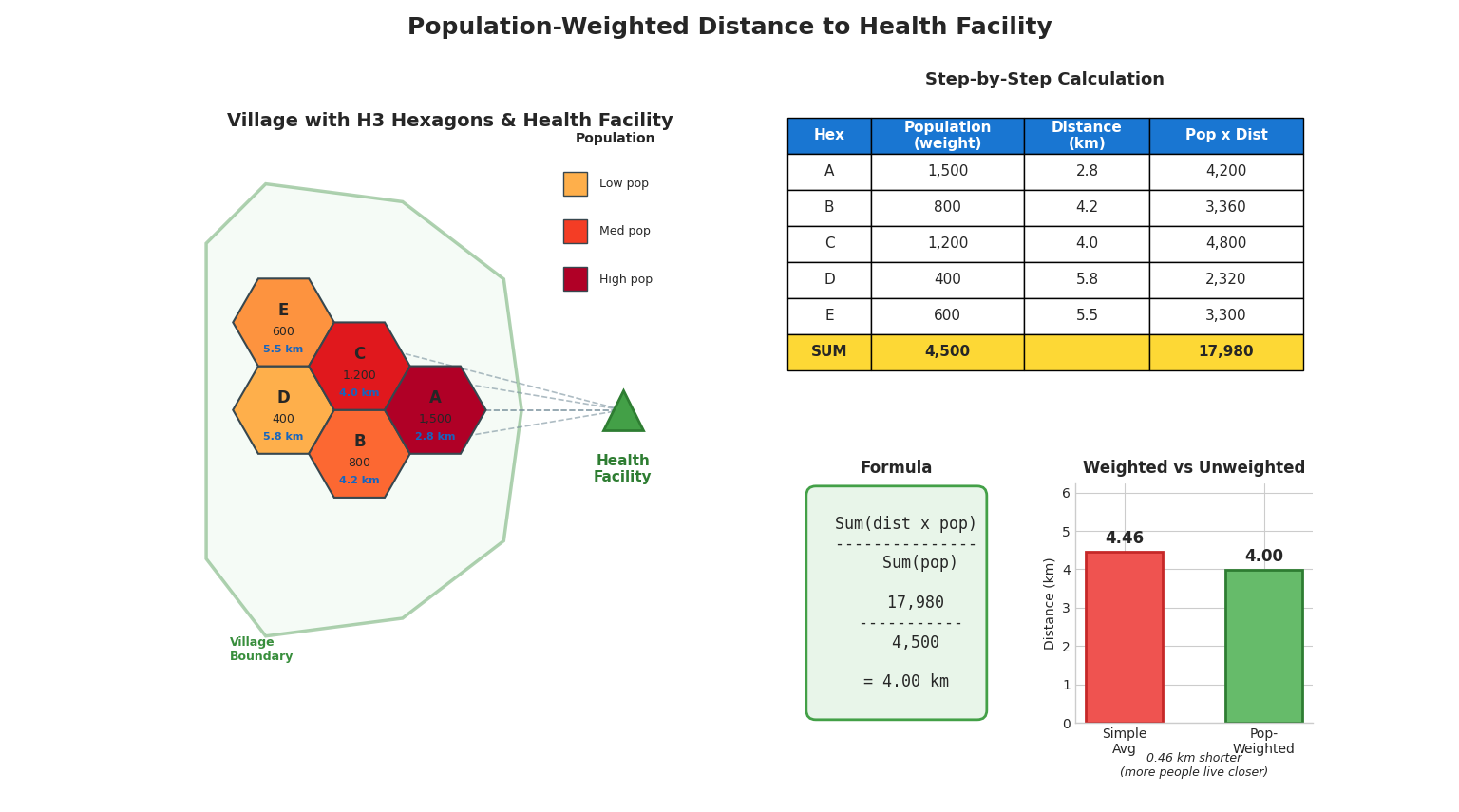
Population Weighting Methodology using Carto H3 Hexagonal Tessellation

Click image to enlarge

01
🍃

Air Quality

15 indicators
NDVI
Normalized Difference Vegetation Index (-1 to 1, unitless)
Kenya0.02 [-0.01, 0.21] P95: 0.40
Mozambique0.14 [-0.01, 0.39] P95: 0.57
The Gambia0.13 [0.09, 0.17] P95: 0.30
All Sites0.12 [0.01, 0.21] P95: 0.46

Dataset

Landsat7, Landsat 8, MODIS - MOD09GA/Q1, MODIS Terra Daily NDVI

Methodology

Residential greenness has been consistently associated with improved pregnancy outcomes and overall population health (Lee et al. 2020). Satellite-derived vegetation indices, particularly the Normalized Difference Vegetation Index (NDVI), are widely used as proxy measures of environmental quality and exposure to air pollution (Sedda et al. 2015). NDVI leverages the differential reflectance of vegetation in the visible red (RED) and near-infrared (NIR) spectral bands, with higher values indicating denser and healthier vegetation cover and, indirectly, lower levels of ambient air pollution.

NDVI = (NIR - RED) / (NIR + RED) Village-level greenness was quantified by spatially averaging NDVI values, calculated as the mean of all NDVI pixels contained within each village boundary.

Rationale

Satellite-derived vegetation indices, particularly NDVI, are widely used as proxy measures of environmental quality and exposure to air pollution. Higher values indicate denser and healthier vegetation cover. NDVI values range from -1 to 1, where values closer to 1 indicate dense, healthy vegetation.

References

Lee KJ, et al. (2020) Greenness, civil environment, and pregnancy outcomes. Environ Health 19:91. | Sedda L, et al. (2015) Poverty, health and satellite-derived vegetation indices. Int Health 7(2):99-106.

Distance to Highways
Population-Weighted Euclidean Distance (km)
Kenya1.8 [0.5, 3.1] P95: 5.4
Mozambique1.0 [0.4, 7.2] P95: 8.1
The Gambia0.6 [0.6, 4.7] P95: 8.4
All Sites1.3 [0.5, 3.7] P95: 8.1

Dataset

OSM Road dataset, WorldPop population raster, Village shapefile

Methodology

Residential proximity to major roadways is commonly used as a proxy for traffic-related air pollution exposure (Barnett et al. 2011). Epidemiological evidence indicates that women residing within proximity (e.g., ≤200m) to major roads experience an increased risk of adverse pregnancy outcomes, including preterm birth (Hitchins et al. 2000). Pollutants produced by motorized vehicles, such as carbon monoxide (CO), nitrogen oxide (NOx), hydrocarbons (HC), sulphur dioxide (SO2), lead (Pb) and carbon dioxide (CO2), have negative and dangerous impacts on the body (Rapang et al. 2023).

Distance_highway = Σ(Population_i × Distance_i) / Σ(Population_i) where Distance_i represents the Euclidean distance from grid cell i to the nearest highway.

Rationale

Traffic-related pollutant concentrations exhibit a strong spatial gradient, with highest levels adjacent to roads and a non-linear decay with increasing distance. Exposure to vehicle emissions, particularly carbon monoxide (CO), during pregnancy has been identified as a potential factor contributing to low birth weight in infants.

References

Barnett AG, et al. (2011) Increased traffic exposure and negative birth outcomes. Environ Health 10:26. | Hitchins J, et al. (2000) Concentrations of submicrometre particles from vehicle emissions. Atmos Environ 34(1):51-9. | Rapang A, et al. (2023) Effect of CO exposure in pregnant women. J INFO Kesehat 21(4):713-20.

Distance to Major Roads
Population-Weighted Euclidean Distance (km)
Kenya1.3 [0.5, 2.7] P95: 4.9
Mozambique1.0 [0.4, 1.2] P95: 4.9
The Gambia0.5 [0.5, 2.1] P95: 8.1
All Sites1.0 [0.4, 2.7] P95: 6.9

Dataset

OSM Road dataset, WorldPop population data 100m resolution

Methodology

Population-weighted Euclidean distance to the nearest major road was computed using the same methodology as for highways, reflecting spatial variation in exposure to traffic-related pollution sources.

Distance_major_road = Σ(Population_i × Distance_i) / Σ(Population_i) where Distance_i represents the Euclidean distance from grid cell i to the nearest major road.
Elevation
Altitude (meters above sea level)
Kenya188.8 [169.2, 192.2] P95: 199.6
Mozambique19.0 [18.6, 33.1] P95: 44.6
The Gambia26.6 [15.3, 26.6] P95: 35.6
All Sites35.4 [19.9, 182.1] P95: 199.6

Dataset

Digital Elevation Model (DEM) - MERIT/DEM/v1_0_3: Elevation in meters, referenced to EGM96 geoid model

Methodology

Elevation influences atmospheric pressure and air circulation patterns, which can affect the dispersion and concentration of air pollutants at a given location (Burton et al. 2025). Village-level altitude was derived by calculating the mean elevation pixel value within each village or neighbourhood boundary.

Rationale

In addition to affecting air pollutant dispersion, exposure to high-altitude environments has been associated with adverse reproductive and pregnancy outcomes, including low birth weight and increased risk of pregnancy complications (Burton et al. 2025).

References

Burton GJ, et al. (2025) Pregnancy at high altitude: the challenge of hypoxia. Phil Trans R Soc B 380(1933):20240167.

PM2.5
Fine Particulate Matter (μg/m³)
Kenya12.9 [10.2, 16.8] P95: 26.9
Mozambique13.2 [8.7, 19.9] P95: 32.9
The Gambia47.8 [30.6, 73.5] P95: 140.9
All Sites14.9 [10.5, 24.4] P95: 73.5

Dataset

Global High Air Pollutants (GHAP) PM2.5 Concentrations, Copernicus Atmosphere Monitoring Service (CAMS) Global Reanalysis (EAC4)

Methodology

Air pollution is one of the top five health risk factors, contributing to 6.67 million deaths worldwide in 2019 (Zhong et al. 2025). Pregnant women and neonates with exposure to high levels of air pollutants are at increased risk of adverse health outcomes such as maternal hypertensive disorders, postpartum depression, placental abruption, low birth weight, preterm birth, infant mortality, and adverse lung and respiratory effects (Aguilera et al. 2023). Metrics were calculated by spatially averaging within a village's boundary.

Rationale

Exposure to fine particulate matter (PM2.5) has been associated with adverse maternal and birth outcomes, including increased risk of gestational hypertension and reduced birth weight (Makanga et al. 2019). Inhalation of ambient PM2.5 has been shown to cross the placenta and has been linked to adverse obstetric and postnatal metabolic health outcomes (Kaur et al. 2022).

References

Zhong K, et al. (2025) Susceptible window identification of maternal ozone exposure and preterm birth. Int Health. | Aguilera J, et al. (2023) Air pollution and pregnancy. Semin Perinatol 47(8):151838. | Kaur K, et al. (2022) PM2.5 exposure during pregnancy and placental lipid metabolic genes. Environ Res 211:113066.

Non-Fire Smoke PM2.5
Background Particulate Matter (μg/m³)
Kenya5.2 [3.7, 8.0] P95: 16.6
Mozambique4.2 [3.0, 6.2] P95: 12.7
The Gambia42.2 [15.4, 67.9] P95: 115.5
All Sites5.3 [3.6, 11.1] P95: 67.1

Dataset

Finnish Meteorological Institute (FMI) - Global smoke PM2.5 estimates

Rationale

Non-fire smoke PM2.5 represents background particulate matter from sources other than biomass burning, including industrial emissions, vehicle exhaust, and dust. This component contributes to chronic air pollution exposure during pregnancy.

Fire Smoke PM2.5
Biomass Burning Particulate Matter (μg/m³)
Kenya0.0 [0.0, 0.1] P95: 0.6
Mozambique0.1 [0.0, 0.4] P95: 2.0
The Gambia0.1 [0.0, 0.6] P95: 1.9
All Sites0.1 [0.0, 0.2] P95: 1.5

Dataset

Finnish Meteorological Institute (FMI) - Global smoke PM2.5 estimates

Rationale

Fire smoke PM2.5 captures particulate matter from biomass burning events including agricultural fires and wildfires. Seasonal burning patterns in sub-Saharan Africa can create acute exposure episodes during pregnancy.

Total AOD
Total Aerosol Optical Depth (dimensionless)
Kenya0.2 [0.1, 0.2] P95: 0.4
Mozambique0.1 [0.1, 0.1] P95: 0.4
The Gambia0.3 [0.2, 0.5] P95: 0.8
All Sites0.2 [0.1, 0.3] P95: 0.5

Dataset

CAMS Global Reanalysis (EAC4)

Rationale

Aerosol Optical Depth (AOD) is a measure of the extinction of solar radiation by aerosols in the atmospheric column. Higher values indicate greater atmospheric particle loading from all sources.

Dust AOD
Dust Aerosol Optical Depth (dimensionless)
Kenya0.0 [0.0, 0.0] P95: 0.1
Mozambique0.0 [0.0, 0.0] P95: 0.0
The Gambia0.2 [0.1, 0.3] P95: 0.5
All Sites0.0 [0.0, 0.0] P95: 0.3

Dataset

CAMS Global Reanalysis (EAC4)

Rationale

Dust AOD specifically captures desert dust aerosols. The Gambia's proximity to the Sahara Desert explains its higher dust loading compared to East African sites.

Black Carbon AOD
Black Carbon Aerosol Optical Depth (dimensionless)
Kenya0.0 [0.0, 0.0] P95: 0.0
Mozambique0.0 [0.0, 0.0] P95: 0.0
The Gambia0.0 [0.0, 0.0] P95: 0.0
All Sites0.0 [0.0, 0.0] P95: 0.0

Dataset

CAMS Global Reanalysis (EAC4)

Rationale

Black carbon aerosols originate primarily from incomplete combustion of fossil fuels and biomass burning. They contribute to respiratory and cardiovascular health impacts during pregnancy.

Carbon Monoxide (CO)
Total Column (g/m²)
Kenya0.8 [0.7, 0.8] P95: 1.0
Mozambique0.7 [0.7, 0.9] P95: 1.1
The Gambia1.0 [0.9, 1.0] P95: 1.2
All Sites0.8 [0.7, 0.9] P95: 1.1

Dataset

CAMS Global Reanalysis (EAC4)

Rationale

At a threshold of >2 ppm, CO was associated with lower mean birth-weight and higher rates of SGA and PTB, with a dose-response relationship (Galka et al. 2025). Acute CO poisoning in pregnant women is linked to complications such as preterm birth and miscarriage, with outcomes influenced by severity of maternal poisoning and stage of foetal development (Place et al. 2025). Exposure to vehicle emissions, particularly CO, during pregnancy has been identified as a potential factor contributing to low birth weight (Rapang et al. 2023).

References

Galka K, et al. (2025) Carbon monoxide levels and adverse pregnancy outcomes. Acta Obstet Gynecol Scand 104(12):2237-43. | Place E, et al. (2025) Carbon monoxide exposure in pregnant women in the UK. BMC Pregnancy Childbirth 25(1):1063.

Nitrogen Dioxide (NO2)
Total Column (μmol/m²)
Kenya0.02 [0.02, 0.03] P95: 0.03
Mozambique0.03 [0.03, 0.04] P95: 0.07
The Gambia0.05 [0.04, 0.05] P95: 0.07
All Sites0.03 [0.02, 0.04] P95: 0.06

Dataset

CAMS Global Reanalysis (EAC4)

Rationale

Short-term exposure to NO2 may induce increased risk of Spontaneous Abortion (SAB) outpatient visits, especially in elder women and cool seasons (Liang et al. 2021).

References

Liang Z, et al. (2021) Short-term ambient nitrogen dioxide exposure is associated with increased risk of spontaneous abortion. Ecotoxicol Environ Saf 224:112633.

Ozone (O3)
Total Column (Dobson Units)
Kenya265.2 [259.6, 270.0] P95: 276.3
Mozambique272.1 [265.4, 283.4] P95: 297.2
The Gambia268.9 [259.6, 276.5] P95: 287.0
All Sites267.6 [261.2, 274.0] P95: 290.0

Dataset

CAMS Global Reanalysis (EAC4)

Rationale

There is some positive correlation between Ozone (O3) and Preterm Birth which is mostly pronounced during middle pregnancy (Zhong et al. 2025).

References

Zhong K, et al. (2025) Susceptible window identification of maternal ozone exposure and preterm birth. Int Health ihaf073.

Sulfur Dioxide (SO2)
Total Column (Dobson Units)
Kenya0.0 [0.0, 0.0] P95: 0.0
Mozambique0.1 [0.0, 0.1] P95: 0.3
The Gambia0.1 [0.1, 0.2] P95: 0.3
All Sites0.0 [0.0, 0.1] P95: 0.2

Dataset

CAMS Global Reanalysis (EAC4)

Rationale

Sulfur dioxide (SO2) is a gaseous pollutant produced by fossil fuel combustion and volcanic activity. Exposure during pregnancy has been associated with respiratory symptoms and adverse birth outcomes.

Road Network Density
Population-Weighted (km⁻¹)
Kenya4.0 [2.1, 17.5] P95: 20.9
Mozambique9.9 [5.2, 11.7] P95: 11.7
The Gambia12.6 [7.2, 18.0] P95: 18.0
All Sites9.0 [2.7, 13.1] P95: 19.1

Dataset

OSM Road dataset, WorldPop population data 100m resolution

Methodology

Exposure to traffic-related pollution has been associated with increased risk of adverse pregnancy outcomes. Road density is commonly used as a spatial proxy for traffic intensity and associated vehicular emissions, with populations residing in communities with dense road networks experiencing higher exposure levels (Phillips et al. 2021).

Road Density_PW = Σ(Population_i × RoadDensity_i) / Σ(Population_i) where RoadDensity_i represents road length per unit area within grid cell i, and Population_i denotes the population of grid cell i.

References

Phillips BB, et al. (2021) Spatial extent of road pollution: A national analysis. Sci Total Environ 773:145589.

02
🏥

Spatial Access to Care

7 indicators
Road Quality Index
RQI (0 to 1, dimensionless)
Kenya0.5 [0.5, 0.6] P95: 0.6
Mozambique0.4 [0.4, 0.5] P95: 0.5
The Gambia0.4 [0.4, 0.5] P95: 0.7
All Sites0.5 [0.4, 0.5] P95: 0.6

Dataset

OSM Road dataset, WorldPop population data 100m resolution

Methodology

Road Quality Index (RQI) is derived from OpenStreetMap road network data combined with WorldPop gridded population estimates. The index quantifies the quality of road infrastructure accessible to residential populations by weighting road segments by their estimated speed limits.

RQI = Σ(RoadLength_i × SpeedLimit_i) / Σ(RoadLength_i) / 120 where RoadLength_i is the length of road segment i, SpeedLimit_i is the estimated speed limit (km/h) based on road class, and 120 km/h normalizes to the maximum highway speed. Lower RQI values indicate poorer road conditions.

Rationale

Road quality influences travel speed and accessibility to health facilities, with poorer road conditions associated with longer travel times and reduced access to maternal healthcare services. The quality of road infrastructure is a critical determinant of the "second delay" in maternal healthcare access - the delay in reaching an appropriate facility once the decision to seek care has been made (44).

Walking Distance to Facility
Population-Weighted Network Distance (km)
Kenya3.0 [1.5, 4.4] P95: 28.7
Mozambique3.6 [3.3, 5.6] P95: 23.3
The Gambia1.6 [1.3, 6.7] P95: 11.6
All Sites3.1 [1.5, 5.1] P95: 22.2

Dataset

OpenRouteService API (foot-walking profile), WorldPop 100m, Health facility locations from national registries

Methodology

Population-weighted walking distance to the nearest health facility providing maternal healthcare services. Distances are computed using network routing algorithms that account for pedestrian pathways and terrain.

PW_WalkDist_Fac = Σ(Pop_i × WalkDist_i) / Σ(Pop_i) where Pop_i is population in grid cell i, WalkDist_i is network walking distance from cell i centroid to nearest health facility (km).

Rationale

Walking distance reflects accessibility for populations without motorized transport. In many sub-Saharan African settings, walking remains the primary mode of transport to health facilities, particularly for routine antenatal care visits (44).

Walking Time to Facility
Population-Weighted Network Time (minutes)
Kenya35.7 [18.3, 52.9] P95: 344.3
Mozambique43.7 [39.6, 67.3] P95: 280.1
The Gambia19.2 [15.5, 80.1] P95: 139.4
All Sites37.7 [18.3, 61.2] P95: 266.1

Methodology

Walking time is derived from walking distance using a standard pedestrian walking speed assumption.

Walking Time (min) = Walking Distance (km) × 60 / 5 Assumes average walking speed of 5 km/h, which is consistent with WHO accessibility modeling standards.

Rationale

Time-based accessibility metrics capture the temporal dimension of healthcare access. Walking times exceeding 60 minutes have been associated with reduced antenatal care utilization and increased risk of home delivery without skilled attendance (44).

Driving Distance to Facility
Population-Weighted Network Distance (km)
Kenya3.0 [1.5, 4.4] P95: 28.7
Mozambique3.6 [3.3, 5.6] P95: 23.3
The Gambia1.6 [1.3, 6.7] P95: 11.6
All Sites3.1 [1.5, 5.1] P95: 22.2

Dataset

OpenRouteService API (driving-car profile), WorldPop 100m, Health facility locations from national registries

Methodology

Population-weighted driving distance to the nearest health facility using road network routing. Accounts for road network topology and driving restrictions.

PW_DriveDist_Fac = Σ(Pop_i × DriveDist_i) / Σ(Pop_i) where DriveDist_i is the network driving distance from cell i centroid to nearest health facility (km).

Rationale

Driving distance represents motorized accessibility, which is critical for emergency obstetric care and referrals. Longer driving distances correlate with delays in reaching emergency care for obstetric complications (44).

Driving Time to Facility
Population-Weighted Network Time (minutes)
Kenya4.6 [3.6, 6.0] P95: 28.2
Mozambique5.8 [5.8, 9.9] P95: 43.5
The Gambia3.7 [2.1, 7.9] P95: 14.2
All Sites5.3 [3.6, 6.7] P95: 31.7

Methodology

Driving time is computed using network routing algorithms that account for road type, speed limits, and traffic patterns.

Driving Time = Network-based travel time estimate using road-class-specific speed assumptions: - Highways: 80-100 km/h - Primary roads: 60-80 km/h - Secondary roads: 40-60 km/h - Tertiary/local roads: 20-40 km/h

Rationale

Travel time to nearest facility is a critical determinant of healthcare access. Delays reaching health facilities represent the "second delay" in Thaddeus and Maine's three-delays framework, which is known to elevate risks for adverse maternal outcomes (44).

Public Transport Distance to Facility
Population-Weighted Total Journey Distance (km)
Kenya5.4 [2.2, 9.7] P95: 30.8
Mozambique3.7 [3.1, 4.2] P95: 23.3
The Gambia3.2 [1.5, 10.3] P95: 22.5
All Sites3.7 [1.8, 8.0] P95: 23.3

Methodology

Public transport accessibility models a multi-modal journey combining walking to a pickup point on a main road and vehicle travel to the facility.

TotalDist = WalkToPickup + InVehicleDist where WalkToPickup is walking distance to nearest primary/secondary road with public transport, InVehicleDist is vehicle distance along roads. Public transport assumed to operate only on primary and secondary classified roads.

Rationale

Public transport represents the most common mode of motorized transport for pregnant women in resource-limited settings, particularly for planned antenatal visits. Accessibility via public transport captures the realistic journey patterns of women seeking maternal healthcare (44).

Public Transport Time to Facility
Population-Weighted Total Journey Time (minutes)
Kenya39.2 [24.8, 63.9] P95: 121.2
Mozambique30.4 [26.6, 38.5] P95: 124.4
The Gambia29.1 [23.3, 54.1] P95: 146.9
All Sites33.7 [24.8, 58.0] P95: 126.9

Methodology

Total public transport journey time combines walking, waiting, and in-vehicle components to model realistic travel patterns.

TotalTime = WalkTime + WaitTime + VehicleTime where: - WalkTime = WalkDist / 5 km/h × 60 (minutes) - WaitTime = 20 minutes (fixed, for typical delays) - VehicleTime = InVehicleDist / VehicleSpeed × 60

Rationale

Public transport journey times capture the full temporal burden of healthcare access, including waiting periods that disproportionately affect pregnant women. Journey times exceeding 2 hours are associated with reduced ANC attendance and delayed emergency care seeking (44).

03
🛣

Physical Isolation

2 indicators
Isolation Walking Distance to Major Roads
Population-Weighted Network Distance (km)
Kenya1.9 [0.9, 4.4] P95: 10.1
Mozambique1.3 [0.6, 1.9] P95: 15.2
The Gambia0.7 [0.6, 2.6] P95: 10.4
All Sites1.3 [0.7, 3.9] P95: 10.1

Dataset

OSM Road network (primary/secondary roads), WorldPop 100m

Methodology

Population-weighted walking distance to the nearest primary or secondary road, representing accessibility to major transport corridors.

PW_WalkIso_Major = Σ(Pop_i × WalkDist_MajorRoad_i) / Σ(Pop_i) Major roads defined as OSM highway classes: primary, primary_link, secondary, secondary_link

Rationale

Walking distance to major roads is a proxy for isolation from transport networks. Difficult access to roads is a known barrier to healthcare utilization, particularly affecting women's ability to access public transport for antenatal care (4, 12).

Isolation Walking Distance to Highways
Population-Weighted Network Distance (km)
Kenya2.9 [0.9, 4.9] P95: 10.6
Mozambique1.3 [0.6, 15.1] P95: 16.3
The Gambia0.7 [0.7, 5.1] P95: 10.8
All Sites1.9 [0.7, 5.9] P95: 15.5

Dataset

OSM Road network (trunk/motorway roads), WorldPop 100m

Methodology

Population-weighted walking distance to the nearest highway/trunk road, representing accessibility to national transport corridors.

PW_WalkIso_Highway = Σ(Pop_i × WalkDist_Highway_i) / Σ(Pop_i) Highways defined as OSM highway classes: motorway, motorway_link, trunk, trunk_link

Rationale

Walking distance to highways captures isolation from long-distance transport. Highways typically have inter-city bus services connecting to urban referral hospitals, which is critical for accessing higher-level emergency obstetric care (4, 12, 13).

04
🌡

Heat Exposure and Weather

6 indicators (3 tiers)
Tier 1 - Heat Stress
Wet Bulb Temperature
Heat Stress Index (°C)
Kenya21.4 [19.8, 22.8] P95: 24.3
Mozambique17.1 [14.3, 20.1] P95: 22.9
The Gambia14.7 [8.6, 23.0] P95: 24.6
All Sites20.1 [16.4, 22.3] P95: 24.3

Dataset

ERA-5, MERRA-2 (NASA/GSFC/MERRA/slv/2) - T2MWET band

Methodology

Tier 1 is based on Wet-bulb temperature, extreme hot days and heatwave days. High temperature and humidity increase the risk of adverse pregnancy outcomes, while lower values are generally protective (Basu et al. 2010). Wet-bulb temperature integrates heat and humidity and is a physiologically relevant measure of maternal heat stress (Sherwood & Huber 2010).

Rationale

Wet bulb temperature is a superior heat stress metric as it accounts for the body's inability to cool through sweating in humid conditions. Values above 32°C are dangerous; above 35°C is lethal for prolonged exposure. Pregnant women are especially vulnerable to heat stress. Extreme hot days and heatwaves capture acute and sustained thermal stress beyond average conditions and have been linked to increased risks of preterm birth and stillbirth (McElroy et al. 2022).

References

Basu R, et al. (2010) High ambient temperature and risk of preterm delivery. Am J Epidemiol 172(10). | Sherwood SC, Huber M. (2010) An adaptability limit to climate change due to heat stress. PNAS 107(21):9552-5. | McElroy S, et al. (2022) Extreme heat, preterm birth, and stillbirth. Environ Int 158:106902.

Tier 1 - Heat Stress
Extreme Hot Days
Percentage of Pregnancy (%)
Kenya5.0 [2.9, 6.7] P95: 8.6
Mozambique4.2 [3.7, 6.6] P95: 7.7
The Gambia4.1 [2.8, 7.2] P95: 9.6
Overall4.5 [3.3, 6.7] P95: 8.7

Rationale

Percentage of pregnancy days exposed to extreme heat conditions. Extreme heat exposure during pregnancy affects fetal development through thermoregulatory stress and reduced placental blood flow.

Tier 1 - Heat Stress
Heatwave Days
Percentage of Pregnancy (%)
Kenya0.0 [0.0, 1.5] P95: 4.8
Mozambique0.0 [0.0, 0.0] P95: 2.3
The Gambia0.0 [0.0, 0.8] P95: 4.9
Overall0.0 [0.0, 0.6] P95: 4.4

Rationale

Prolonged heat exposure during heatwave events poses significant risks to maternal and fetal health. Heatwaves are defined as consecutive days exceeding the local 95th percentile temperature threshold.

Tier 2 - Ambient Air
Ambient Temperature
Mean Air Temperature at 2m (°C)
Kenya27.3 [25.7, 28.3] P95: 29.3
Mozambique24.1 [21.5, 26.5] P95: 29.1
The Gambia27.6 [26.2, 28.7] P95: 30.3
All Sites26.7 [24.9, 28.2] P95: 29.5

Dataset

ERA5-Land Hourly (ECMWF/ERA5_LAND/HOURLY)

Methodology

Tier 2 is based on Ambient (2m) air temperature and Diurnal temperature. Ambient air temperature is used as an indicator of environmental heat exposure and has been associated with adverse pregnancy outcomes, with elevated temperatures increasing risk and lower temperatures showing protective effects (Basu et al. 2010).

Rationale

Low temperature and low humidity are protective against preterm birth, whereas high temperature increases risk. Evidence shows that estimated health effects are sensitive to the choice of temperature metric.

Tier 2 - Ambient Air
Diurnal Temperature
Daily Temperature Range (°C)
Kenya6.7 [5.6, 8.0] P95: 10.3
Mozambique8.9 [6.4, 11.8] P95: 14.9
The Gambia12.5 [8.2, 14.5] P95: 16.6
All Sites7.7 [6.1, 10.8] P95: 15.2

Methodology

Diurnal temperature variation reflects intra-day thermal instability rather than absolute heat exposure.

Rationale

Exposure to elevated diurnal temperature variation has been shown to be significantly associated with adverse early-life respiratory outcomes, including childhood pneumonia, indicating an independent exposure pathway related to repeated thermoregulatory stress (Xu et al. 2014).

References

Xu Z, et al. (2014) Temperature variability and childhood pneumonia. Environ Health 13:51.

Tier 3 - Surface Derived
Land Surface Temperature
Surface Temperature (°C)
Kenya28.3 [28.3, 28.9] P95: 29.1
Mozambique29.2 [29.2, 30.1] P95: 30.3
The Gambia26.6 [25.9, 26.6] P95: 26.8
All Sites28.7 [28.3, 29.2] P95: 30.3

Dataset

ERA 5, MODIS, Landsat7, Landsat8

Methodology

Tier 3 is based on Land Surface Temperature (LST). LST represents the radiative temperature of the Earth's surface and is influenced by land cover, vegetation, and urban form.

Rationale

While LST does not directly represent ambient air temperature experienced by individuals, it provides valuable information on spatial heat patterns such as urban heat islands and localised heat accumulation, which shape pregnant women's exposure (Li & Bou-Zeid 2013).

References

Li D, Bou-Zeid E. (2013) Synergistic Interactions between Urban Heat Islands and Heat Waves. J Appl Meteorol Climatol 52(9):2051-64.

05
🌧

Precipitation

1 indicator
Precipitation
Daily Rainfall (mm/day)
Kenya0.0 [0.0, 0.0] P95: 11.8
Mozambique0.0 [0.0, 0.7] P95: 12.6
The Gambia0.0 [0.0, 0.7] P95: 15.9
All Sites0.0 [0.0, 0.4] P95: 13.0

Dataset

PERSIANN-CDR (Precipitation Estimation from Remotely Sensed Information using Artificial Neural Networks - Climate Data Record)

Methodology

Monthly precipitation values were spatially averaged at the village or neighbourhood level.

Rationale

Seasonal variations in precipitation have been associated with fluctuations in birth outcomes, including birth weight and length (Rashid et al. 2017). Rainfall affects food availability, disease transmission, and access to healthcare during wet seasons.

References

Rashid H, et al. (2017) Temperature during pregnancy influences the fetal growth and birth size. Trop Med Health 45:1.

06
💧

Relative Humidity

1 indicator
Relative Humidity
Percentage (%)
Kenya72.4 [68.6, 76.6] P95: 82.7
Mozambique69.8 [63.7, 75.0] P95: 82.3
The Gambia55.6 [38.8, 77.7] P95: 87.2
All Sites70.9 [65.3, 76.2] P95: 84.2

Dataset

ECMWF/ERA5_LAND/HOURLY

Methodology

RH calculated using Magnus-Tetens approximation: e_s(T) = exp((a × T)/(b + T)) e_s(T_d) = exp((a × T_d)/(b + T_d)) RH = 100 × (e_s(T_dew) / e_s(T_air)) where T is air temperature (°C), T_d is dew point temperature (°C), a=17.625, b=243.04

Rationale

Low relative humidity has been associated with reduced risk of preterm birth, whereas high relative humidity increases risk (Wu et al. 2023). Humidity affects thermal comfort, disease transmission, and food storage/safety.

References

Wu Y, et al. (2023) Effects of ambient temperature and relative humidity on preterm birth. Front Public Health 11:1101283.

07
🌱

Soil Micro-Nutrients

4 indicators
Calcium (Ca)
Extractable Calcium (ppm)
Kenya62.5 [61.7, 63.0] P95: 64.5
Mozambique60.1 [60.1, 67.8] P95: 68.6
The Gambia62.7 [61.5, 62.7] P95: 64.7
All Sites62.5 [61.6, 63.3] P95: 68.6

Dataset

ISDASOIL/Africa/v1/calcium_extractable (iSDAsoil 30m Resolution)

Methodology

Values for each raster are averaged per neighbourhood/village boundary.

Rationale

Soil calcium affects food crop mineral content. Calcium is critical during pregnancy for fetal bone development, blood clotting, and muscle function. Maternal calcium deficiency is associated with preeclampsia and low birth weight.

Nitrogen (N)
Total Nitrogen (g/kg)
Kenya57.7 [56.2, 72.3] P95: 80.5
Mozambique53.8 [52.9, 62.6] P95: 78.5
The Gambia49.1 [48.3, 52.8] P95: 58.2
All Sites56.2 [52.9, 63.5] P95: 78.5

Dataset

ISDASOIL/Africa/v1/nitrogen_total (iSDAsoil 30m Resolution)

Rationale

Soil nitrogen is essential for plant protein synthesis and crop productivity. Low soil nitrogen contributes to food insecurity and maternal malnutrition.

Phosphorus (P)
Extractable Phosphorus (ppm)
Kenya25.1 [23.6, 25.3] P95: 25.8
Mozambique24.3 [24.1, 24.6] P95: 25.4
The Gambia23.6 [23.6, 23.8] P95: 24.9
All Sites24.2 [23.6, 25.1] P95: 25.5

Dataset

ISDASOIL/Africa/v1/phosphorus_extractable

Rationale

Phosphorus is essential for root development and crop yield. Deficient soils produce lower crop yields affecting household food security.

Potassium (K)
Extractable Potassium (ppm)
Kenya46.2 [45.8, 46.4] P95: 47.2
Mozambique45.3 [44.8, 47.8] P95: 49.4
The Gambia41.8 [41.2, 42.2] P95: 42.2
All Sites45.8 [44.8, 46.4] P95: 48.3

Dataset

ISDASOIL/Africa/v1/potassium_extractable

Rationale

Potassium regulates water uptake and disease resistance in plants, affecting agricultural productivity and food security.

08
🏙

Urban Form

1 indicator
Settlement Classification
Degree of Urbanization (categorical)
KenyaPeri-Urban: 26.1% | Rural: 8.0% | Urban: 65.8%
MozambiquePeri-Urban: 7.1% | Rural: 20.5% | Urban: 72.3%
The GambiaPeri-Urban: 0.2% | Rural: 60.3% | Urban: 39.5%
All SitesPeri-Urban: 14.7% | Rural: 21.9% | Urban: 63.4%

Dataset

Global Human Settlement Layer (JRC/GHSL/P2023A/GHS_SMOD/2025)

Methodology

Classification based on MODE (most frequent value): - smod_code 22-30: URBAN - smod_code 14-21: PERI-URBAN - smod_code 11-13: RURAL

Rationale

The ongoing urbanization worldwide is leading to an increasing number of pregnant women being exposed to higher levels of urban-related environmental hazards such as air pollution and noise, and at the same time, having less contact with natural environments. The urban environment during pregnancy may influence child's respiratory health (Li et al. 2025).

References

Li F, et al. (2025) The silent threat: effects of PM2.5 exposure on perinatal complications and neonatal outcomes. BMC Pregnancy Childbirth 25(1):686.

09
🌎

IPCC Climate Zone

1 indicator
IPCC Climate Zone
Climate Classification (categorical)
Tropical DryKenya: 97.2% | Mozambique: 99.9% | Gambia: 98.6% | All: 98.4%
Tropical MoistKenya: 1.0% | Mozambique: 0.0% | Gambia: 1.4% | All: 0.8%
Tropical MontaneKenya: 0.4% | All: 0.2%
Warm Temperate DryKenya: 1.2% | All: 0.6%

Dataset

WorldPop Population Data, IPCC Climate Zones TIF

Methodology

Climate zones were assigned using the Intergovernmental Panel on Climate Change (IPCC) climate classification, based on long-term temperature and precipitation patterns (46). Village-level climate zones were determined using a population-weighted dominant classification.

Climate Zone = argmax_z [Σ(Population_i | Climate_i = z)] This method ensures assigned climate zones represent conditions experienced by most village residents.

Rationale

Climate zone classification provides contextual information relevant to environmental exposures during pregnancy, including thermal regimes and seasonal variability (47).

References

IPCC (2023) Climate Change 2021 – The Physical Science Basis. Cambridge University Press. | Watts N, et al. (2019) The 2019 report of The Lancet Countdown on health and climate change. Lancet 394(10211):1836-78.

10
💡

Wealth and Development Indicators

2 indicators
VIIRS Nighttime Lights
Radiance (nW/cm²/sr)
Kenya3.0 [1.1, 5.6] P95: 6.7
Mozambique2.9 [0.6, 6.6] P95: 8.7
The Gambia0.5 [0.0, 1.6] P95: 1.7
All Sites1.9 [0.8, 5.5] P95: 8.3

Dataset

ee.ImageCollection("NOAA/VIIRS/DNB/ANNUAL_V21"), WorldPop Population Data, Village Shapefiles

Methodology

VIIRS nighttime light intensity is widely used as a proxy for human settlement density, infrastructure development, and socioeconomic activity. Nighttime lights correlate strongly with population distribution, electrification, income, and access to services (Jean et al. 2016).

NTL_PW = Σ(Population_i × NTL_i) / Σ(Population_i) This population-weighted approach ensures nighttime light estimates reflect conditions experienced by most village residents rather than uninhabited areas.

References

Jean N, et al. (2016) Combining satellite imagery and machine learning to predict poverty. Science 353(6301):790-4. | Chen X, Nordhaus WD. (2011) Using luminosity data as a proxy for economic statistics. PNAS 108(21):8589-94.

Relative Wealth Index
RWI (dimensionless, relative scale)
Kenya0.6 [0.2, 0.8] P95: 1.0
Mozambique0.3 [0.2, 0.4] P95: 0.9
The Gambia-0.1 [-0.4, 0.5] P95: 0.5
All Sites0.3 [0.1, 0.6] P95: 1.0

Dataset

WorldPop Population Data, Village Shapefiles, HDX Relative Wealth Index (93 Low and Middle Income Countries)

Methodology

The Relative Wealth Index (RWI) is a high-resolution, machine-learning-derived proxy of relative household wealth developed by Meta Data for Good and validated against Demographic and Health Survey (DHS) wealth indices (Jean et al. 2016). RWI provides a continuous measure of socioeconomic status, with values interpreted relative to the national wealth distribution.

RWI_PW = Σ(Population_i × RWI_i) / Σ(Population_i) This population-weighted approach ensures wealth estimates reflect socioeconomic conditions experienced by most village residents.

Rationale

Village-level socioeconomic context was estimated using a population-weighted RWI, accounting for within-village population distribution (Victora et al. 2008; Marmot et al. 2008).

References

Jean N, et al. (2016) Combining satellite imagery and machine learning to predict poverty. Science 353(6301):790-4. | Victora CG, et al. (2008) Maternal and child undernutrition. Lancet 371(9609):340-57. | Marmot M, et al. (2008) Closing the gap in a generation. Lancet 372(9650):1661-9.

11
👥

Socio-Geographic Characteristics

8 indicators
Social Inclusion
Community Group Participation (%)
Kenya3.8%
Mozambique6.9%
The Gambia9.3%
All Sites5.9%

Methodology

Proportion of pregnant women who are aware of and actively participate in community groups or organisations (formal or informal) that provide support for pregnancy-related problems. Derived from survey questions assessing awareness and active participation through meeting attendance, financial contributions, or advocacy.

Rationale

This indicator captures social inclusion during pregnancy by reflecting engagement in community-based support and health promotion structures that help reduce social exclusion during the prenatal period (Victora et al. 2008).

References

Victora CG, et al. (2008) Maternal and child undernutrition. Lancet 371(9609):340-57.

Community Help
Bonding Social Capital (%)
Kenya75.0%
Mozambique51.3%
The Gambia49.6%
All Sites62.7%

Methodology

Proportion of pregnant women who report having access to help from neighbours or other families in their community if pregnancy-related problems arise. Responses of "don't know" were recoded as "no" (yes=1; no/don't know=0).

Rationale

Bonding social capital (strong ties of trust with neighbours, family, friends) acts through psychosocial support mechanisms to improve pregnancy health (Schölmerich et al. 2014).

References

Schölmerich VLN, et al. (2014) Neighborhood Social Capital and Pregnancy Outcomes. PLoS ONE 9(5):e95873.

General Financial Autonomy
Household Decision-Making (%)
Kenya68.8%
Mozambique50.6%
The Gambia72.9%
All Sites64.0%

Methodology

Derived from the survey question: "Who makes the decisions about money in your household?" Women who identified themselves as the primary decision-maker were classified as having financial autonomy.

Rationale

Women who make household financial decisions have greater chances of receiving antenatal and delivery care. The indicator reflects women's financial autonomy, a key dimension of gender power relations (Girardi et al. 2023).

References

Girardi G, et al. (2023) Social determinants of health in pregnant individuals. Int J Equity Health 22(1):186.

Pregnancy Financial Autonomy
Pregnancy-Related Decision-Making (%)
Kenya62.5%
Mozambique54.2%
The Gambia81.1%
All Sites63.7%

Methodology

Derived from the survey question: "Who makes decisions about money related to pregnancy and pregnancy care?" Women who identified themselves as the primary decision-maker were classified as having pregnancy-related financial autonomy.

Rationale

Women with financial autonomy on pregnancy-related issues have greater uptake of antenatal care, skilled birth attendance, use of maternal health services, and improved birth outcomes (Makanga et al. 2019).

References

Makanga PT, et al. (2019) Place-specific factors associated with adverse maternal and perinatal outcomes in Southern Mozambique. BMJ Open 9(2):e024042.

Partner Availability
Living with Partner (%)
Kenya80.3%
Mozambique63.1%
The Gambia66.3%
All Sites72.1%

Methodology

Derived from survey questions assessing whether the respondent currently lives alone, and if not, whether she currently lives with a partner. This indicator captures physical partner availability through shared residence but does not capture non-cohabiting partner support.

Rationale

Pregnant women with involved partners are more likely to receive prenatal care. Partner involvement is associated with better neonatal outcomes and reduced maternal morbidity (Wang et al. 2020).

References

Wang E, et al. (2020) Social Determinants of Pregnancy-Related Mortality and Morbidity in the United States. Obstet Gynecol 135(4):896-915.

Emotional Support
Community Emotional Support (%)
Kenya39.3%
Mozambique23.8%
The Gambia28.2%
All Sites32.5%

Methodology

Derived from the survey question on types of community support received, with women classified as receiving emotional support if they selected "emotional or moral support."

Rationale

Low social support is associated with depression, anxiety, and may indirectly raise risk for adverse birth outcomes through stress-related pathways (Bedaso et al. 2021).

References

Bedaso A, et al. (2021) The relationship between social support and mental health problems during pregnancy. Reprod Health 18(1):162.

Transport Support
Social Transport Access (%)
Kenya25.1%
Mozambique19.9%
The Gambia17.5%
All Sites21.9%

Methodology

Derived from the survey question on types of community support received, with women classified as having transport support if "transport" was selected as a form of assistance.

Rationale

Emergency maternal transport services are essential for improving outcomes. Access to community-based transport support is critical for timely use of antenatal and emergency maternal health services (Girardi et al. 2023).

References

Girardi G, et al. (2023) Social determinants of health in pregnant individuals. Int J Equity Health 22(1):186.

Financial Support
Social Financial Support (%)
Kenya5.4%
Mozambique7.1%
The Gambia0.4%
All Sites4.9%

Methodology

Derived from the survey question on types of community support received, with women classified as having financial support if "financial support" was selected as a form of assistance.

Rationale

Financial constraints significantly hinder women's access to antenatal care in low- and middle-income countries. Access to community-based financial support can reduce economic barriers to maternal health service use (Banke-Thomas et al. 2020).

References

Banke-Thomas A, et al. (2020) Cost of Utilising Maternal Health Services in Low- and Middle-Income Countries. Int J Health Policy Manag.

References

1. Lee KJ, Moon H, Yun HR, Park EL, Park AR, Choi H, et al. Greenness, civil environment, and pregnancy outcomes: perspectives with a systematic review and meta-analysis. Environ Health. 2020;19(1):91.
2. Sedda L, Tatem AJ, Morley DW, Atkinson PM, Wardrop NA, Pezzulo C, et al. Poverty, health and satellite-derived vegetation indices: their inter-spatial relationship in West Africa. International Health. 2015;7(2):99-106.
3. Barnett AG, Plonka K, Seow WK, Wilson LA, Hansen C. Increased traffic exposure and negative birth outcomes: a prospective cohort in Australia. Environ Health. 2011;10(1):26.
4. Hitchins J, Morawska L, Wolff R, Gilbert D. Concentrations of submicrometre particles from vehicle emissions near a major road. Atmos Environ. 2000;34(1):51-9.
5. Rapang A, Bara FT, Kusmiyati Y, Supahar S, Nopiyanti N. The Effect of Exposure to Carbon Monoxide (CO) Gas in Pregnant Women on The Incident of Weight Infants Born in Makassar City. J INFO Kesehat. 2023;21(4):713-20.
6. Phillips BB, Bullock JM, Osborne JL, Gaston KJ. Spatial extent of road pollution: A national analysis. Sci Total Environ. 2021;773:145589.
7. Burton GJ, Moore LG, Giussani DA, Murray AJ. Pregnancy at high altitude: the challenge of hypoxia. Phil Trans R Soc B. 2025;380(1933):20240167.
8. Zhong K, Yang R, Liu X, He J, Wen C, Zhu Z, et al. Susceptible window identification of the relationship between maternal ozone exposure and preterm birth. Int Health. 2025;ihaf073.
9. Aguilera J, Konvinse K, Lee A, Maecker H, Prunicki M, Mahalingaiah S, et al. Air pollution and pregnancy. Semin Perinatol. 2023;47(8):151838.
10. Makanga PT, Sacoor C, Schuurman N, Lee T, Vilanculo FC, Munguambe K, et al. Place-specific factors associated with adverse maternal and perinatal outcomes in Southern Mozambique: a retrospective cohort study. BMJ Open. 2019;9(2):e024042.
11. Kaur K, Lesseur C, Deyssenroth MA, Kloog I, Schwartz JD, Marsit CJ, et al. PM2.5 exposure during pregnancy is associated with altered placental expression of lipid metabolic genes. Environ Res. 2022;211:113066.
12. Galka K, Shea M, Aye CYL, Impey L. Carbon monoxide levels, smoking and adverse pregnancy outcomes. Acta Obstet Gynecol Scand. 2025;104(12):2237-43.
13. Place E, Wareing H, Herigstad M. Carbon monoxide exposure in pregnant women in the UK. BMC Pregnancy Childbirth. 2025;25(1):1063.
14. Liang Z, Xu C, Liang S, Cai TJ, Yang N, Li SD, et al. Short-term ambient nitrogen dioxide exposure is associated with increased risk of spontaneous abortion. Ecotoxicol Environ Saf. 2021;224:112633.
15. Basu R, Malig B, Ostro B. High Ambient Temperature and the Risk of Preterm Delivery. Am J Epidemiol. 2010;172(10).
16. Sherwood SC, Huber M. An adaptability limit to climate change due to heat stress. PNAS. 2010;107(21):9552-5.
17. McElroy S, Ilango S, Dimitrova A, Gershunov A, Benmarhnia T. Extreme heat, preterm birth, and stillbirth: A global analysis across 14 lower-middle income countries. Environ Int. 2022;158:106902.
18. Xu Z, Hu W, Tong S. Temperature variability and childhood pneumonia: an ecological study. Environ Health. 2014;13(1):51.
19. Li D, Bou-Zeid E. Synergistic Interactions between Urban Heat Islands and Heat Waves: The Impact in Cities Is Larger than the Sum of Its Parts. J Appl Meteorol Climatol. 2013;52(9):2051-64.
20. Wu Y, Yuan J, Yuan Y, Kong C, Jing W, Liu J, et al. Effects of ambient temperature and relative humidity on preterm birth during early pregnancy and before parturition in China. Front Public Health. 2023;11:1101283.
21. Rashid H, Kagami M, Ferdous F, Ma E, Terao T, Hayashi T, et al. Temperature during pregnancy influences the fetal growth and birth size. Trop Med Health. 2017;45(1):1.
22. Olapoju OM. Access to healthcare and impediment(s) of transport: examining lived experience of pregnant women in selected local governments of Oyo state, Nigeria. Discov Health Syst. 2025;4(1):17.
23. Li F, Liu X, Gong S, Li P, Gao Y, Guo X, et al. The silent threat: effects of PM2.5 exposure on perinatal complications and neonatal outcomes. BMC Pregnancy Childbirth. 2025;25(1):686.
24. IPCC. Climate Change 2021 – The Physical Science Basis: Working Group I Contribution to the Sixth Assessment Report. Cambridge University Press; 2023.
25. Watts N, Amann M, Arnell N, Ayeb-Karlsson S, Belesova K, Boykoff M, et al. The 2019 report of The Lancet Countdown on health and climate change. Lancet. 2019;394(10211):1836-78.
26. Jean N, Burke M, Xie M, Davis WM, Lobell DB, Ermon S. Combining satellite imagery and machine learning to predict poverty. Science. 2016;353(6301):790-4.
27. Chen X, Nordhaus WD. Using luminosity data as a proxy for economic statistics. PNAS. 2011;108(21):8589-94.
28. Victora CG, Adair L, Fall C, Hallal PC, Martorell R, Richter L, et al. Maternal and child undernutrition: consequences for adult health and human capital. Lancet. 2008;371(9609):340-57.
29. Marmot M, Friel S, Bell R, Houweling TAJ, Taylor S. Closing the gap in a generation: health equity through action on the social determinants of health. Lancet. 2008;372(9650):1661-9.
30. Schölmerich VLN, Erdem Ö, Borsboom G, Ghorashi H, Groenewegen P, Steegers EAP, et al. The Association of Neighborhood Social Capital and Ethnic (Minority) Density with Pregnancy Outcomes in the Netherlands. PLoS ONE. 2014;9(5):e95873.
31. Girardi G, Longo M, Bremer AA. Social determinants of health in pregnant individuals from underrepresented, understudied, and underreported populations in the United States. Int J Equity Health. 2023;22(1):186.
32. Wang E, Glazer KB, Howell EA, Janevic TM. Social Determinants of Pregnancy-Related Mortality and Morbidity in the United States: A Systematic Review. Obstet Gynecol. 2020;135(4):896-915.
33. Bedaso A, Adams J, Peng W, Sibbritt D. The relationship between social support and mental health problems during pregnancy: a systematic review and meta-analysis. Reprod Health. 2021;18(1):162.
34. Banke-Thomas A, Ayomoh FI, Abejirinde IOO, Banke-Thomas O, Eboreime EA, Ameh CA. Cost of Utilising Maternal Health Services in Low- and Middle-Income Countries: A Systematic Review. Int J Health Policy Manag. 2020.
35. Gage AJ, Guirlene Calixte M. Physical accessibility of maternal health services. Popul Stud. 2006;60(3):271-88.
36. Rylander C, Odland JØ, Sandanger TM. Climate change and maternal and pregnancy outcomes. Glob Health Action. 2013;6(1):1-9.

Explore Participant Data

Loading participant data...